A red fox is stepping carefully over a fallen branch beneath tall pines. Show the weight shift through the spine and supporting legs.
Sketch focus: Rib cage, pelvis, paws, and balance.Animal Drawing Prompt Generator
Generate an animal drawing prompt with a coherent species, movement, habitat, anatomy focus, difficulty, and optional timer. Choose forest, grassland, wetland, coast, or home and farm subjects, then lock and reroll any part.
- Habitat-based animal pools
- Anatomy difficulty presets
- Movement and pose prompts
- Free text prompts
Text prompts are always free. AI reference images are optional.
Your next sketch starts here.
Pick a focus, difficulty, and time. We will turn those choices into one specific idea you can draw right away.
Animal prompt examples built around movement and habitat
Animal drawing becomes easier to plan when the prompt connects body structure to a believable action. Each example names the weight shift, major forms, or viewing angle to practice.
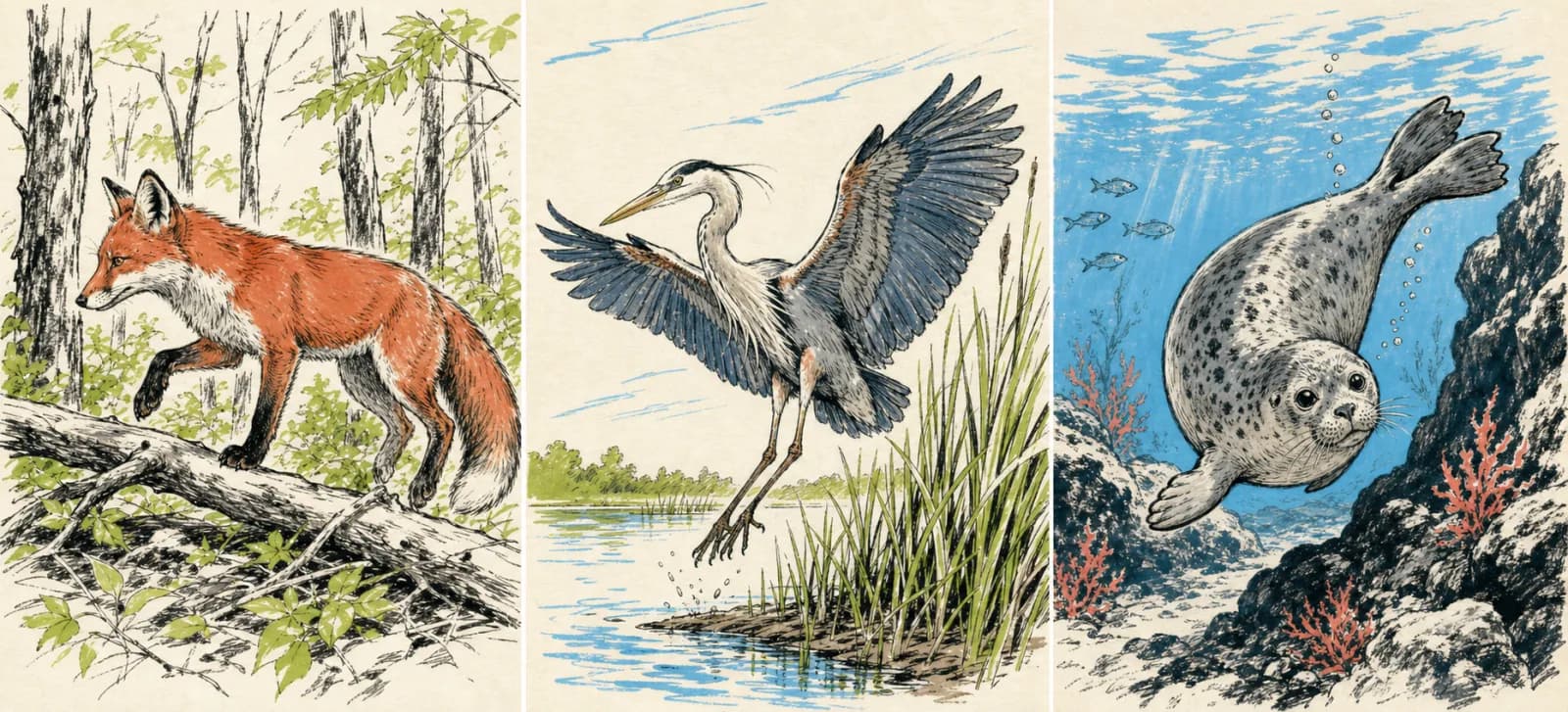
A great blue heron is landing at the edge of a reed bed with both wings open. Use overlapping forms to make the pose feel three-dimensional.
Sketch focus: Wing rhythm, long legs, and landing gesture.A harbor seal is turning through clear coastal water beside dark rocks. Keep the rounded body volume readable as it turns toward the viewer.
Sketch focus: Body mass, flippers, and foreshortening.Every animal prompt keeps habitat and anatomy connected
The animal generator uses separate prompt parts so a new species does not produce a mismatched habitat or an anatomy note unrelated to the pose.
Animal subject
The selected habitat draws from a matching species pool: forest, grassland, wetland, coast and ocean, or home and farm.
Movement or pose
The action creates a weight shift, turn, landing, stretch, or resting pose that can be studied rather than copied as a symbol.
Habitat
A compact setting explains the ground plane, nearby shapes, and how the animal occupies its environment.
Anatomy + drawing brief
Difficulty changes the focus from large body shapes to joints, weight-bearing structure, and foreshortening.
Practice the relationship between form, movement, and habitat
Animal studies can fail when anatomy is separated from motion. Use these three lenses to decide what the sketch must explain first.
Let the environment support the pose
A branch, shoreline, reed bed, or barn step gives the animal a believable contact point and helps you judge scale.
- Draw the ground or water line before small background details.
- Use one habitat shape to clarify scale and balance.
- Keep the setting simple enough that the animal remains the focal point.
Animal difficulty changes the anatomy goal
Choose the level by what you want to understand, not by how much fur or texture you plan to add.
Level or timePrompt scopeDrawing focus
Very Easy / EasyTwo or three body masses, side view, simple contact pointSilhouette and basic proportion
MediumTurning or moving pose with visible joints and weight shiftGesture, spine, shoulders, pelvis, and limbs
HardUnusual angle, overlap, foreshortening, and habitat depthThree-dimensional anatomy and balance
Use animal prompts for studies, warm-ups, and illustration ideas
Wildlife sketch practice
Choose a forest, grassland, wetland, or coastal habitat and focus on one readable movement rather than a detailed finished rendering.
Pet and farm animal studies
Use familiar contact points such as a doorway, blanket, paddock, or barn step to study posture and weight.
Bird and marine anatomy
Practice wings, long legs, fins, curved body masses, and movement through air or water with a targeted pose.
Creature design reference
Study real animal structure first, then carry the spine, limb rhythm, or weight distribution into an original creature design.
An animal drawing prompt is more than a species name
A random animal list answers what to draw. A drawing prompt also answers what the animal is doing, where it is, and which anatomy problem to solve.
Coherent habitat
The selected habitat controls both the subject pool and the setting, so a coastal study does not unexpectedly become a farm scene.
Anatomy-aware difficulty
Easy prompts emphasize large shapes; harder prompts introduce weight-bearing joints, overlap, and foreshortening.
Movement before texture
The action and drawing brief prioritize gesture and body structure before fur, feathers, scales, or markings.
Keep the prompt, change one part, or request a reference
Generated text, settings, timer state, and saved prompts stay in this browser. Copy the prompt, save it locally, share the seeded URL, or request an optional AI reference after the text prompt appears.
Lock and reroll
Preserve the strongest subject, action, setting, or drawing brief and change only the unlocked parts.
Local save and seeded sharing
Save up to 50 prompts in this browser or copy a link that restores the same seed and settings.
Optional AI reference
The text prompt comes first. Reference images are requested separately and follow the current guest beta limit.
Continue with a related drawing workflow
Choose the next generator by what you want to practice, not by a synonym for the same task.
Animal Drawing Prompt Generator FAQ
Answers about prompt controls, drawing practice, saving, and optional references.
What does the animal drawing prompt generator create? +
It creates a text prompt combining an animal, a movement or pose, a coherent habitat, an anatomy focus, a difficulty level, and an optional time limit.
Can I choose the type of animal habitat? +
Yes. Choose Surprise Me, Forest, Grassland, Wetland, Coast and Ocean, or Home and Farm. The animal and setting pools change together.
How does difficulty affect animal anatomy prompts? +
Very Easy and Easy focus on large shapes and proportion. Medium adds gesture, joints, and weight shift. Hard adds unusual angles, overlap, and foreshortening.
Can I lock an animal and reroll the habitat or movement? +
Yes. After generating a prompt, lock the animal subject or any other prompt part, then reroll only the parts you want to change.
Is the animal drawing prompt generator free? +
Yes. Text prompts, timers, copying, local saving, and seeded sharing are free without an account. Optional AI reference images have a separate beta limit.
Generate one prompt and start with the biggest shapes.
Free text prompts. No account required.